1 Overview
In Veilforge you summon creatures to defend your ideals, arm your allies with powerful equipment and technology, and cast spells to turn the tide of battle. Lead your heroes to victory and crush the opposition. Veilforge can be played with 2 or 4 players.
2 What You Need
Each player brings:
- A main deck of 40 to 80 cards
- An evolution deck of up to 16 cards (evolved heroes, creatures, or structures); this deck is optional
- 3 hero cards
- 1 ideal card
Deck-building rules
- Only one copy of any given hero card; heroes and ideals are never placed in your main deck.
- No more than 4 copies of the same card in your main deck.
- Your ideal and every card in your main and evolution decks must be from the same setting as one of your 3 heroes.
3 Setup
- Place your 3 hero cards in your hero zone and your ideal card in your ideal zone.
- Shuffle your main deck thoroughly.
- Draw 5 cards to form your starting hand.
- Determine who goes first (coin flip, die roll, etc.).
- The player who goes second starts the game with 1 mana.
- Begin the game and follow the turn phases below.
Your starting life equals the combined health of your 3 heroes.
4-player games
Teammates sit next to each other, with opponents across the table. Both players on a team take their turns at the same time, moving through all five phases together, and then the opposing team takes their turns. Each player has their own zones, hand, deck, and life total, but you may manipulate your teammate's zones as if they were your own. When teammates' abilities would resolve at the same time, the team chooses the order, and either teammate may add a card to a chain when the team has a chance to respond. Both players on the team that goes second start with 1 mana. A team loses only when both of its players have lost, and the last team standing wins.
4 How to Win
A player loses the game when any of the following happens:
- Their life is reduced to 0 or less.
- They must draw a card but their main deck is empty.
- They must add mana from their main deck but it is empty.
The last player (or team) remaining wins.
5 The Battlefield
Each player controls the same set of zones, laid out like the board you see in Play:
This is your half of the board. Your opponent's field is the mirror image above yours.
Zone by zone:
- Hero Zone (3 slots): where your 3 hero cards live. Heroes can activate their abilities from here unless a card says otherwise, and can normally be summoned to the battle zone. When a hero is removed from the battle or support zone in any way it returns here disabled, and if a hero in the battle or support zone would be destroyed it returns here disabled instead. Whenever a hero returns to the hero zone, every card attached to it is sent to the graveyard unless an effect says otherwise. Heroes in the hero zone can never be attacked.
- Ideal Zone: holds your single ideal card, which must share a setting with at least one of your heroes. Your ideal represents the core belief or ultimate goal of your heroes and can completely change how an archetype is normally played.
- Life: your starting life equals the combined health of your 3 heroes at the start of the game. If your life is reduced to 0 or less, you lose.
- Hand: the cards you have available to play. You begin with 5 and draw 1 at the start of each of your turns (the first player skips their draw on turn 1). There is no maximum hand size.
- Battle Zone (5 slots): where creatures and heroes fight head to head. Cards here can use their abilities, attack the opponent's battle-zone cards, or attack the opponent directly. Cards are disabled when summoned and can't act until your next turn unless stated otherwise. Each card in your battle zone, enabled or disabled, reduces the damage of a direct attack on you by 1.
- Support Zone (5 slots): where structures, events, equipment, technology, spells, and sometimes heroes or creatures are placed. Cards here are disabled when summoned and can't attack or be attacked unless stated otherwise. Events, spells, equipment, and technology are always played here first to resolve their text, and are not subject to the enabled or disabled states.
- Mana Zone (up to 12): face-down cards from the top of your deck that act as mana. During your mana phase you gain 3 mana by adding the top 3 cards of your deck face-down. When you consume mana, return the consumed cards to the top of your deck, and if you consume more than one at once you choose the order they go back. Mana enters face-down; some abilities flip it face-up, and face-up mana is flipped back face-down before it returns to your deck.
- Main Deck: your 40 to 80 card library of creatures, spells, structures, equipment, technology, and events, all from the same setting as one of your heroes. You draw from it and feed it into your mana zone.
- Graveyard: where cards go after being destroyed, used, or discarded. When a card's effect resolves or it is defeated in battle, it is sent here. Cards in the graveyard are normally no longer in play, though some abilities can be used from it or bring cards back.
- Evolution Deck: a separate deck of up to 16 evolved heroes, creatures, and structures. You evolve into these cards only when their requirements are met (see Evolution).
- Banish Zone: where cards go when removed from the game entirely by an effect. Banished cards are not in play and can't be interacted with unless a specific effect allows it.
6 Turn Phases
A turn has five phases, in order:
1 · Start
Restore every card on both players' fields to full health and enable your disabled cards.
2 · Draw
Draw 1 card. The player who goes first skips this on their very first turn.
3 · Mana
Add the top 3 cards of your deck face-down into your mana zone.
4 · Action
In any order, play cards, activate abilities, and attack. An enabled hero or creature may attack once per turn unless stated otherwise (see Combat for how attacks resolve).
5 · End
Resolve any end-of-turn abilities, then the next player's start phase begins.
7 Combat
During your action phase, an enabled hero or creature in your battle zone may attack once per turn unless a card says otherwise. There are two ways to attack:
- Direct attack: attack the opponent directly. It deals damage equal to the attacker's damage, reduced by 1 for each card in the defender's battle zone, to a minimum of 0.
- Attacking the battle zone: attack a card in the opponent's battle zone. The attacker deals its damage to that card. The defender only deals damage back if it has the Counterattack passive, in which case it deals its damage to the attacker after taking the hit. Any card whose health is reduced to 0 is destroyed.
Cards in the support zone can only be attacked if a passive or active ability explicitly allows it, and heroes in the hero zone can never be attacked.
8 Card States
- Enabled: the card is ready to attack or activate an ability. After it attacks or activates an ability, it is disabled by turning it 90 degrees.
- Disabled: the card cannot attack or activate abilities. Heroes, creatures, and structures enter the battle or support zone disabled and can't act until your next turn unless stated otherwise. A disabled card in the battle zone can still be attacked. Events, spells, equipment, and technology are played to the support zone and count as enabled for the purpose of resolving their text.
- Exhausted: a heavier version of disabled, shown by turning the card 180 degrees. It cannot attack or activate abilities. At the start of its controller's next turn it becomes disabled rather than enabled, and only enables normally the turn after that.
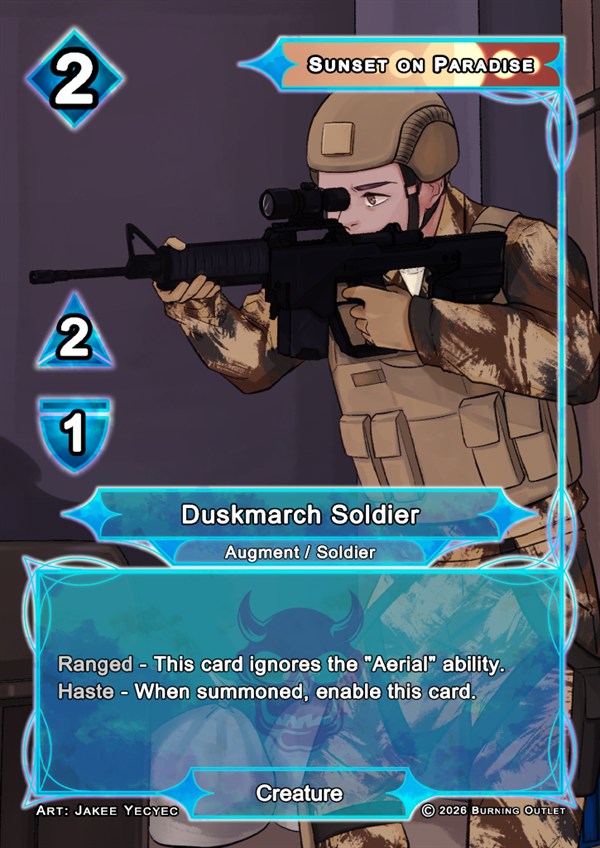
9 Card Anatomy
Every card shares the same frame. Here's a Hero card, part by part:
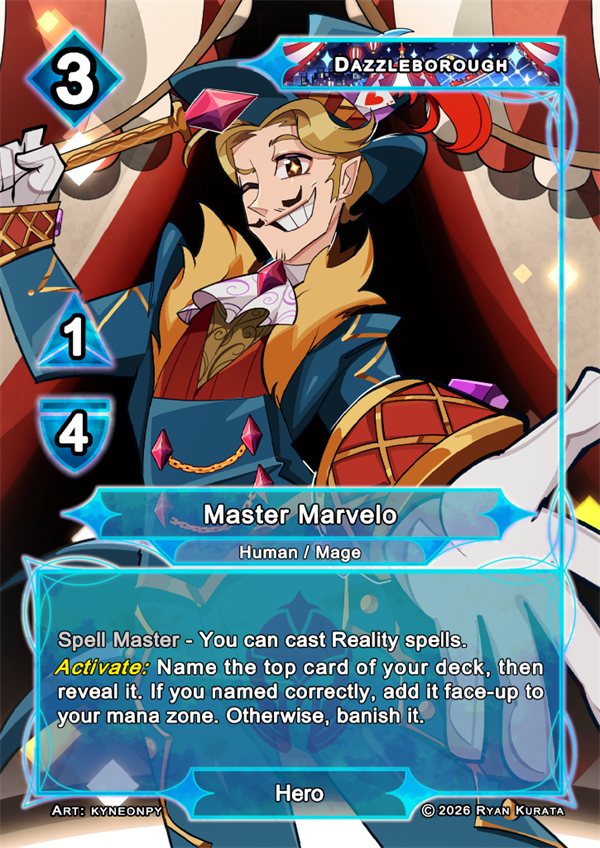
- Cost: top-left diamond. The mana you pay to play the card.
- Setting: top-right banner. The universe the card is from (used only for deck-building).
- Damage
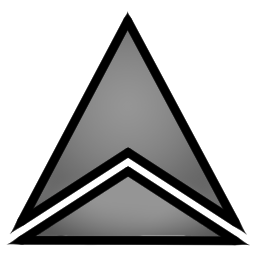 : upper-left. Dealt when this card attacks.
 - Health
 : lower-left shield. The card is destroyed when this reaches 0.
 - Name: the central banner. You may run up to 4 copies of the same name in your main deck.
- Class: below the name (here, Human / Mage). What abilities and spells can target; a card may have several, split by " / ".
- Ability: the text box. What the card does (passives use a dash, actives a colon).
- Type: the bottom banner. One of the 8 card types.
- Artist: credited in the bottom corner.
10 Card Types
There are eight card types:
11 Card Abilities
Passive abilities are always active, even while the card is disabled. Their keywords are written in gray and use a dash, e.g. Counterattack -. Active abilities must be activated; their keywords are written in yellow and use a colon, e.g. Activate:
Active abilities
- Activate: usable only while the card is enabled in your hero, battle, or support zone (unless stated otherwise).
- Evolution: used only from your evolution deck, when its requirements are met, to transform a card into an evolved form (see Evolution).
- Hand: used while the card is in your hand; it's played from your hand and resolves in your support zone.
- Graveyard: used while the card is in your graveyard, and resolves there.
- Quick: a reaction played from your hand on either player's turn, in response to an action. It starts or continues a chain. You need the mana and an empty support slot; the card stays in support until the chain resolves (if it fails to resolve, it's destroyed).
- Vigilant: a reaction used from the field on either player's turn, in response to an action. The card must be on the field and enabled. It also starts or continues a chain.
- Quick Evolution: follows both the Quick and Evolution rules, and is played from the evolution deck as a reaction on either player's turn. It does not require an open support slot.
12 Chains
A chain forms when a Quick or Vigilant ability is used in response to an action. Only Quick and Vigilant abilities can be added to a chain; nothing else can respond. You may even respond to your own action.
Players alternate, each adding one card at a time in response to the last. When everyone passes, the chain resolves in reverse order: last in, first out.
13 Evolution
Your evolution deck holds up to 16 evolved heroes, creatures, and structures. When a card's Evolution requirements are met, you can evolve a card in play into it:
- Evolved heroes: move all attachments from the base hero onto the evolved hero, remove the base hero from the game (not the banish zone), then the evolved hero takes its place and adopts its card state.
- Evolved creatures: summoned to your battle zone (or support, if the ability allows) following the Evolution text, in the disabled state unless stated otherwise.
- Evolved structures: summoned to your support zone following the Evolution text, disabled unless stated otherwise.
14 Glossary
- Action
- Anything a player does that changes the state of the game, such as playing a card, activating an ability, declaring an attack, or drawing a card. Players may only respond to an action with Quick or Vigilant abilities.
- Attachment
- A card attached to another card (its "main card"). Equipment, technology, and attaching spells are first played to an empty support slot to resolve their text, then leave that slot and attach. Attached cards don't occupy a slot, and are sent to the graveyard when the main card leaves play unless an effect says otherwise.
- Banish
- Send a card to the banish zone. Banished cards are removed from the game and normally cannot be interacted with.
- Chain
- The stack of responses created when players respond to actions with Quick or Vigilant abilities. Chains resolve last in, first out.
- Class
- A category like Soldier, Vampire, Mage, or A.I., shown under a card's name and used by other cards' abilities to find valid targets. A card may have several classes split by " / ", and counts as each of them for all purposes.
- Consume
- Reduce your mana by the stated amount.
- Damage
- A card's damage value, used when it attacks.
- Destroy
- Move a card to the graveyard.
- Direct attack
- An attack made against the opponent's life rather than a card. It deals the attacker's damage, reduced by 1 for each card in the defender's battle zone (minimum 0).
- Discard
- Move a card from your hand to the graveyard.
- Enable / Disable
- An enabled card is upright and ready to act. Attacking or activating an ability disables it (turned 90 degrees), and it can't act again until it enables at the start of your next turn.
- Evolve
- Bring an evolved card from your evolution deck into play, or transform a card into it, once its Evolution requirement is met. See Evolution.
- Exhaust
- A heavier disable, shown by turning a card 180 degrees. An exhausted card becomes disabled at the start of your next turn and only enables the turn after that.
- Face-down / Face-up mana
- Mana enters the mana zone face-down. If an effect flips it face-up, it stays face-up until an effect flips it back or it leaves the mana zone.
- Flip
- Turn a face-down card face-up, or vice versa, without changing zones.
- Health
- A card's health value. When it reaches 0, the card is destroyed.
- Life
- Your life total, equal to the combined health of your 3 heroes at the start of the game. You lose if it reaches 0 or less.
- Main card
- The card an attachment is attached to.
- Modifier
- A condition in an ability that changes how it works, such as Activate, Quick, Vigilant, or Graveyard.
- Move
- Change a card's zone without removing it from play. The destination needs an open slot or the move fails, and the card keeps its current state and attachments. Moving is not summoning, so on-summon abilities don't trigger.
- Negate
- Cancel a card or ability so it has no effect; a negated card or ability fails to resolve.
- Non-direct attack
- An attack made against a card (in the battle zone, or the support zone via Flanking or Sniping) rather than against the opponent directly. Some cards can only make non-direct attacks.
- Owner / Controller
- The owner is the player whose deck the card began in; the controller is whoever is currently using it.
- Removed from the game
- A card placed outside the game and not in the banish zone. It can never be interacted with by any effect.
- Resolve
- Apply a card or ability's effect in full. It "fails to resolve" if it is negated or no longer has valid targets.
- Return
- Move a card from the field back to its owner's hand.
- Setting
- The universe a card is from. Used only for deck-building; never referenced by abilities, since that's what class is for.
- Summon
- Place a hero or creature in the battle zone, or a structure in the support zone, in a disabled state. Some effects summon to a different zone.
15 FAQ
Do defending cards deal damage when attacked?
Only if the defender has Counterattack. Without it, only the attacker deals damage.
If a Counterattack card is destroyed by the attack, does it still deal its damage?
Yes. Counterattack damage still hits the attacker even if the defending card is destroyed.
Can I attack a card in the support zone?
Only if a passive or active ability explicitly allows it.
Can either player respond with Quick and Vigilant?
Yes. Only Quick and Vigilant abilities can be used in response, and either player may be the first to respond.
How many attachments can a card have?
By default, up to 1 equipment, 1 technology, and 1 spell, with no limit on other card types, unless a card states otherwise.
What does an attached card's "main card" mean?
The main card is simply the card the attachment is attached to.
Can a disabled card use Vigilant abilities?
No. The card must be enabled to use a Vigilant ability.
Do all heroes, creatures, and structures enter play disabled?
Yes. They enter the battle or support zone disabled. If an ability enables them on summon, they're still summoned disabled and then enabled.
What happens when events or spells are played?
They're played to an empty support slot, then sent to the graveyard when they resolve or fail to resolve, unless stated otherwise.
If a card with attachments changes zones, do its attachments move with it?
Yes, except when a hero returns to the hero zone, in which case its attachments are destroyed (sent to the graveyard) unless stated otherwise.
What happens when my deck runs out of cards?
If you must draw a card or add mana and your main deck is empty, you lose the game.
Can I respond to a passive ability with a chain?
No. A passive triggers on its own and isn't an action, so it can't be responded to.
Ready to play?
Pick your setting, build a deck around your heroes, and start dueling.